
Coated paint and persistent marks
Water Spots on Ceramic Coating and What to Do
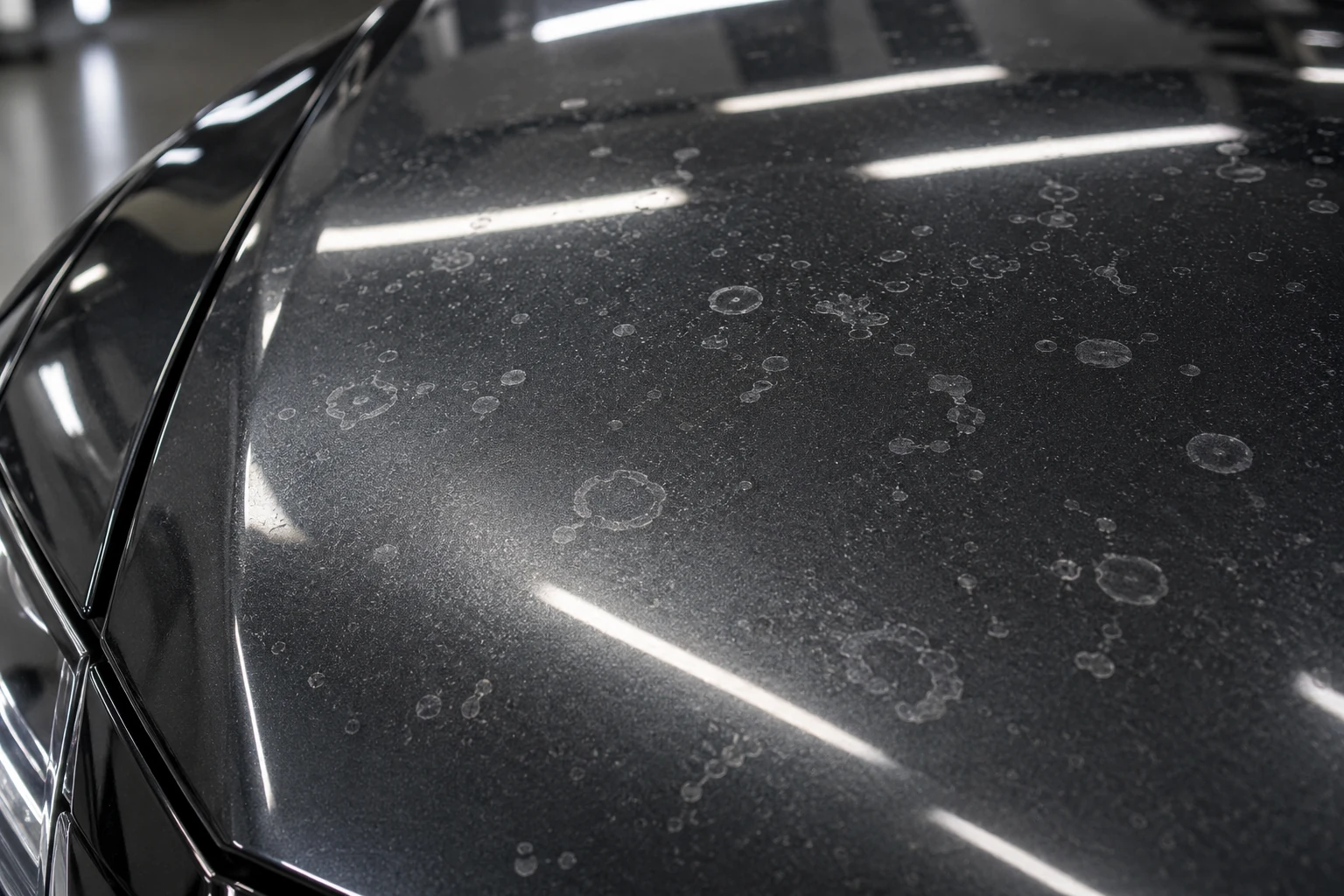
Water spots on ceramic coating may be removable deposits or marks that need professional assessment. Identify the coating and its cure restrictions first. If washing is permitted, follow its approved routine, dry the panel and inspect again. For remaining spots, check compatibility before any dedicated remover. Stop if the finish changes or an approved test fails. Beading alone does not show that the coating or paint is undamaged.
Choose your next step
Fresh or unknown coating
Identify the product and application date. Ask the installer about cure restrictions before treating the marks.
Check the coatingMarks that wash away
If washing is permitted, follow the approved routine and inspect the dry result before adding another product.
Review the wash stepsPersistent or changing marks
Check product compatibility and stop if the approved test fails or the finish changes. Arrange an assessment.
See when to stopIdentify the coating and surface
Identify the coating
Find the coating invoice, warranty record or installer’s handover message. You need the product name, application date and any maintenance products added later.
A spray sealant sold as “ceramic” and a professionally applied coating may have different care limits. Keep the product record available when checking treatment compatibility.
Identify the surface
Confirm the surface too. This guide concerns ceramic coating on painted body panels.
A PPF-covered hood, vinyl roof, coated glass and bare trim need their own surface instructions. Identify these areas before any product is used near their edges.
Recently installed coating
If the coating was recently installed, check its first-wash and chemical restrictions before cleaning. Contact the installer promptly with photographs of unexpected spots during that period. Do not borrow a waiting time from another brand or assume a coating is ready for decontamination because the car has been collected.
When the product is unknown
Ask the previous owner, installer or seller for the invoice and product details. If you cannot identify it, record that uncertainty. Arrange inspection of persistent marks instead of testing several increasingly strong cleaners on an unidentified finish.
Record when the spots appeared
Also note when the spots appeared, where the vehicle was parked, the last wash and anything already applied. A one-sided spray pattern after parking near irrigation suggests a different exposure from rings across every horizontal panel after washing. The pattern helps the investigation, but it does not prove the chemical cause or depth.
Deposits or lasting surface damage
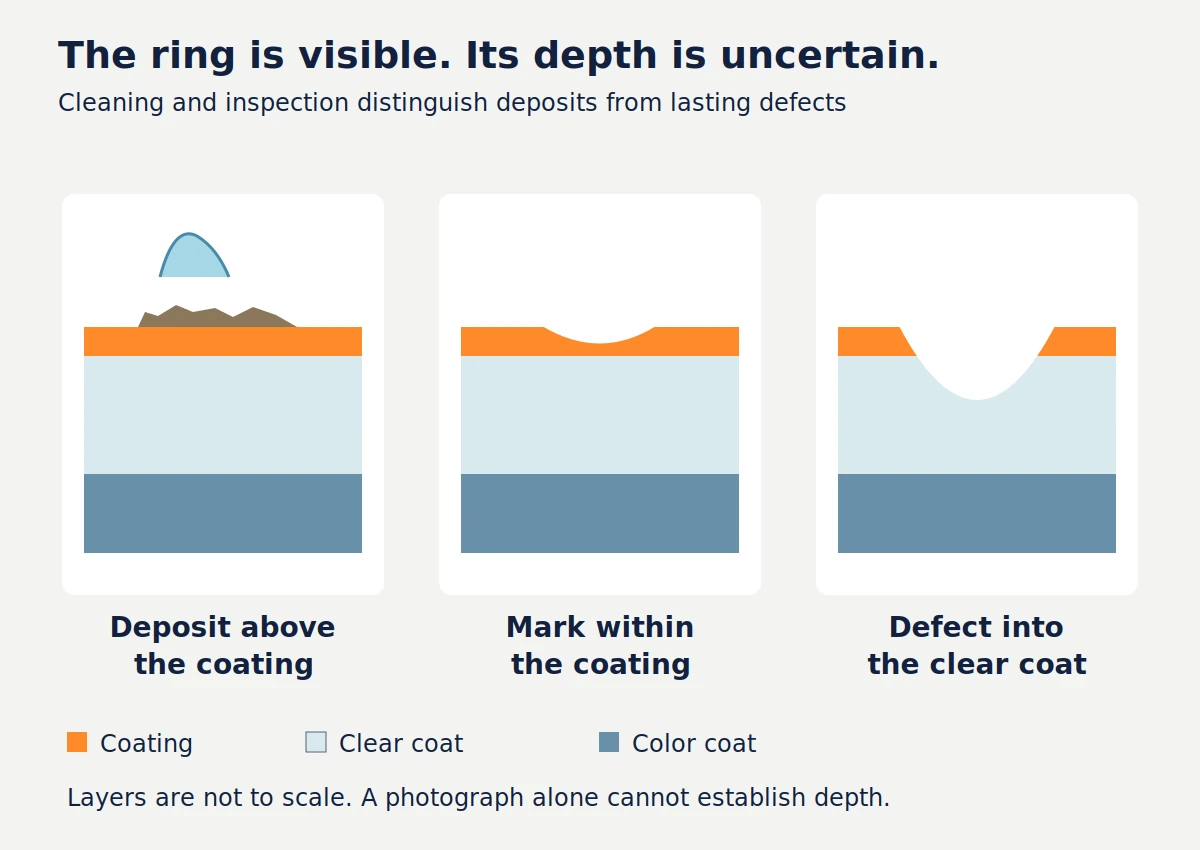
Water can leave visible material behind when it evaporates. Some residue comes away during ordinary coating-approved washing. More persistent deposits can require compatible decontamination. A mark may also remain after the deposit is removed because the coating or paint surface has been affected.
| What you observe | What it can mean | Useful next step |
|---|---|---|
| Marks disappear after an allowed maintenance wash | Removable surface residue was involved. | Dry properly and review the exposure that caused it. |
| Rings remain on clean, dry paint | Bonded deposits or a lasting surface defect may remain. | Check coating-compatible treatment with the installer. |
| An approved test removes the deposit but leaves a shadow | The deposit may not be the whole problem. | Stop and request inspection before further treatment. |
| Haze, streaking or a changed finish follows treatment | The product, residue or application may have affected the surface. | Follow the product’s removal instructions and contact a professional. |
| Marks were visible immediately after coating collection | They may need assessment of preparation or application as well as contamination. | Send the installer the collection date and photographs before altering them. |
Do not use a fingernail, abrasive pad or repeated rubbing as a diagnostic test. A phone photograph can show location and appearance, but it cannot reliably distinguish an upper-surface deposit from damage beneath it. An inspection should start with the least aggressive suitable approach.
Why beading does not prevent spots
Beads can dry in place
Hydrophobic behavior describes how water behaves on the surface. It does not mean every droplet leaves the car before it dries. A stationary bead on a hood can still leave residue, and the original exposure may have introduced contamination along with the water.
Beading is an incomplete test
Beading is also an incomplete check of coating condition. Surface contamination and maintenance products can change what you see. A beading photograph does not establish that the coating has its original performance everywhere or that a spot has not affected the finish.
This is why neither “it still beads” nor “it stopped beading” is enough to choose a repair. First identify the coating and clean it using suitable instructions. Then assess the remaining marks and behavior. Our ceramic coating service explains the wider protection limits and what should be recorded at installation.
For a recurring problem, note whether it follows a particular wash or parking location. That record is more useful for choosing the next step than guessing the water chemistry from the shape of a ring.
Start with an allowed maintenance wash
Keep the first step gentle
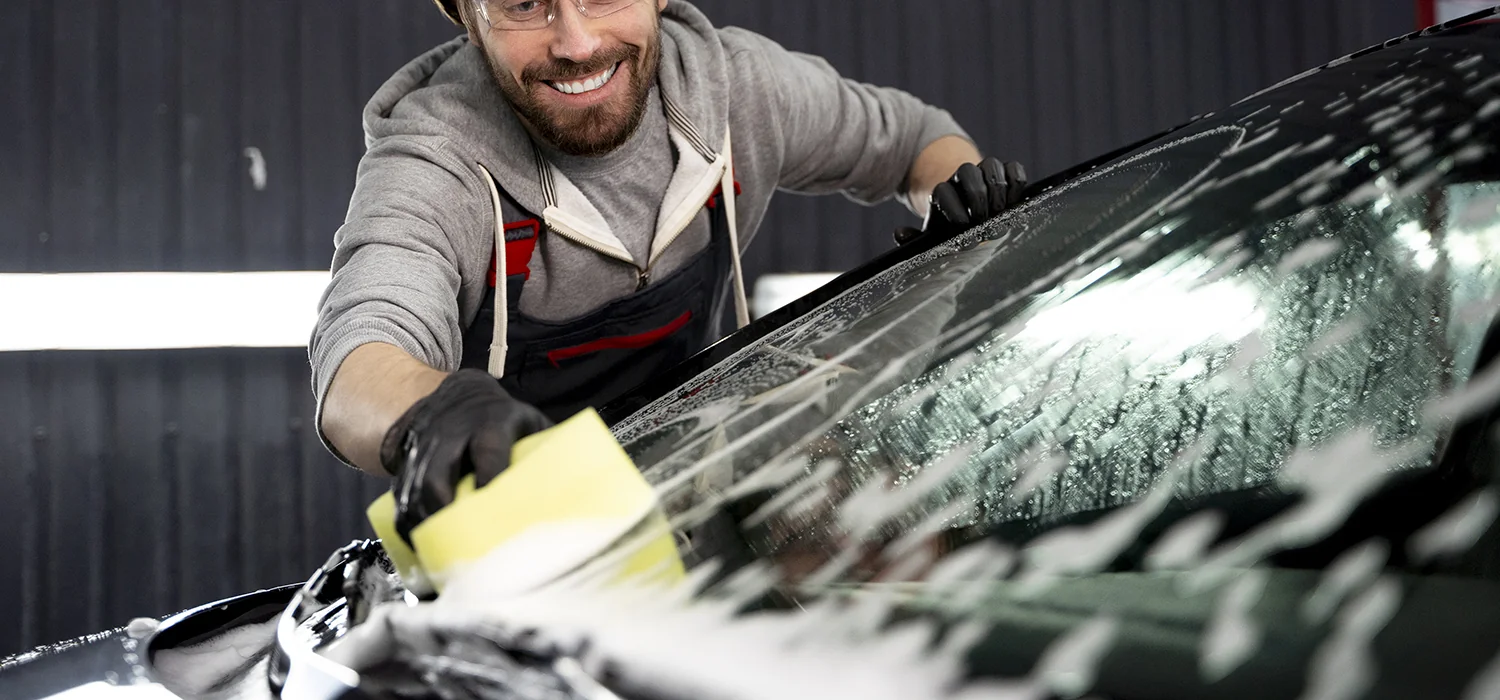
If the coating’s aftercare permits washing, work on cool panels in shade. Use the approved shampoo and clean wash equipment, follow the product instructions, rinse thoroughly and dry with a clean, suitable towel or the approved drying method.
Do not wipe a dusty spotted panel with a dry cloth. Loose grit can introduce scratches while you try to remove the rings. Keep dirty wheel-cleaning equipment away from painted panels.
Care limits
Follow the coating’s wash restrictions.
Working conditions
Use clean equipment on cool panels.
Final check
Rinse, dry and inspect from several angles.
If the marks disappear
Check the dry surface from more than one angle. Wet paint can make a mark less obvious without removing it. If the spots disappear, photograph the result and return to ordinary care. There is no reason to add a water-spot remover or a new coating just because a removable deposit was present.
If the marks remain
If the marks remain, that is a decision point. It is not an instruction to press harder, repeat the wash indefinitely or try a household descaler. Make a record and check the next product with the installer. For a newly installed coating that cannot yet be washed, ask for the appropriate response instead of applying this routine early.
Check remover and coating compatibility
Use the installed coating record to check the current remover label and manufacturer guidance. A generic “coating safe” claim is not enough. The two checks below must agree before a test area is treated.
Check compatibility
- Coating
- Installed coating and cure restrictions
- Surfaces
- Paint, glass, trim and film exclusions
- Instructions
- Current label and manufacturer guidance
Check the application limits
- Preparation
- Working conditions and protective equipment
- Test method
- Contact time and test-area instructions
- Cleanup
- Required removal and rinsing method
Manufacturer examples have different limits
Q²M WaterSpot guidance makes coating compatibility conditional and warns against use on fresh coatings.
Spotless 2.0 guidance identifies use on CQUARTZ coatings and requires cool surfaces away from direct sun.
These are product-specific statements, not blanket approval for an unknown coating.
Test only after compatibility is confirmed
If the coating maker or installer confirms a product is appropriate, use its prescribed test on a small inconspicuous area before wider treatment. Keep the test location identifiable, follow the exact instructions and inspect the clean, dry result. A successful test supports a limited next step. It does not prove every adjacent material or repaired panel will react the same way.
Keep the method unchanged
Do not combine products, lengthen contact time or allow repeated applications beyond the instructions because a stubborn shadow remains. Avoid vinegar mixtures, bathroom descalers and other improvised acid recipes. Their availability at home does not establish compatibility with your finish.
Resolve conflicting instructions
If the label and online instructions disagree, ask the manufacturer or installer which instructions apply to your bottle and coating. Save their answer. Guessing between conflicting procedures is unnecessary when the result could change the appearance of a whole panel.
When to stop and seek inspection
Matte paint, recent repainting and nearby materials with uncertain compatibility need finish-specific advice before stronger treatment. For fresh or unidentified coatings, use the initial coating checks. The conditions below are reasons to pause treatment already under consideration.
The finish changes
New haze, dullness, streaking, color transfer or an uneven gloss is a reason to pause. Follow the used product’s directions for removal or rinsing and tell the inspector exactly what happened.
The approved test does not help
More pressure or a stronger mixture can add damage without addressing the cause. Photograph the test and keep the product details.
A ring remains after cleaning
A remaining outline needs assessment of the coating and paint. Do not assume it can be dissolved with another application.
A warranty may apply
Contact the original installer or warranty issuer before correction or recoating where a claim may apply. Ask what inspection and records they require.
Prepare a useful inspection record
Photograph the dry panel from a wider view, then take a focused close-up under useful light. For any approved test, keep the camera position and lighting similar before and after. Show the remaining mark as well as any improvement. These records help the inspector; they cannot establish damage depth on their own.
Surface record
Coating name and date if known, plus repaint or film history
Exposure record
When the spots appeared, parking conditions and the last wash
Treatment record
Products already used, test location and dry before-and-after views
Ask the inspector to record the test result, the affected panels and the reason for any proposed paid work. A useful recommendation also states what improvement is uncertain and whether renewed protection is included.
What correction and recoating change
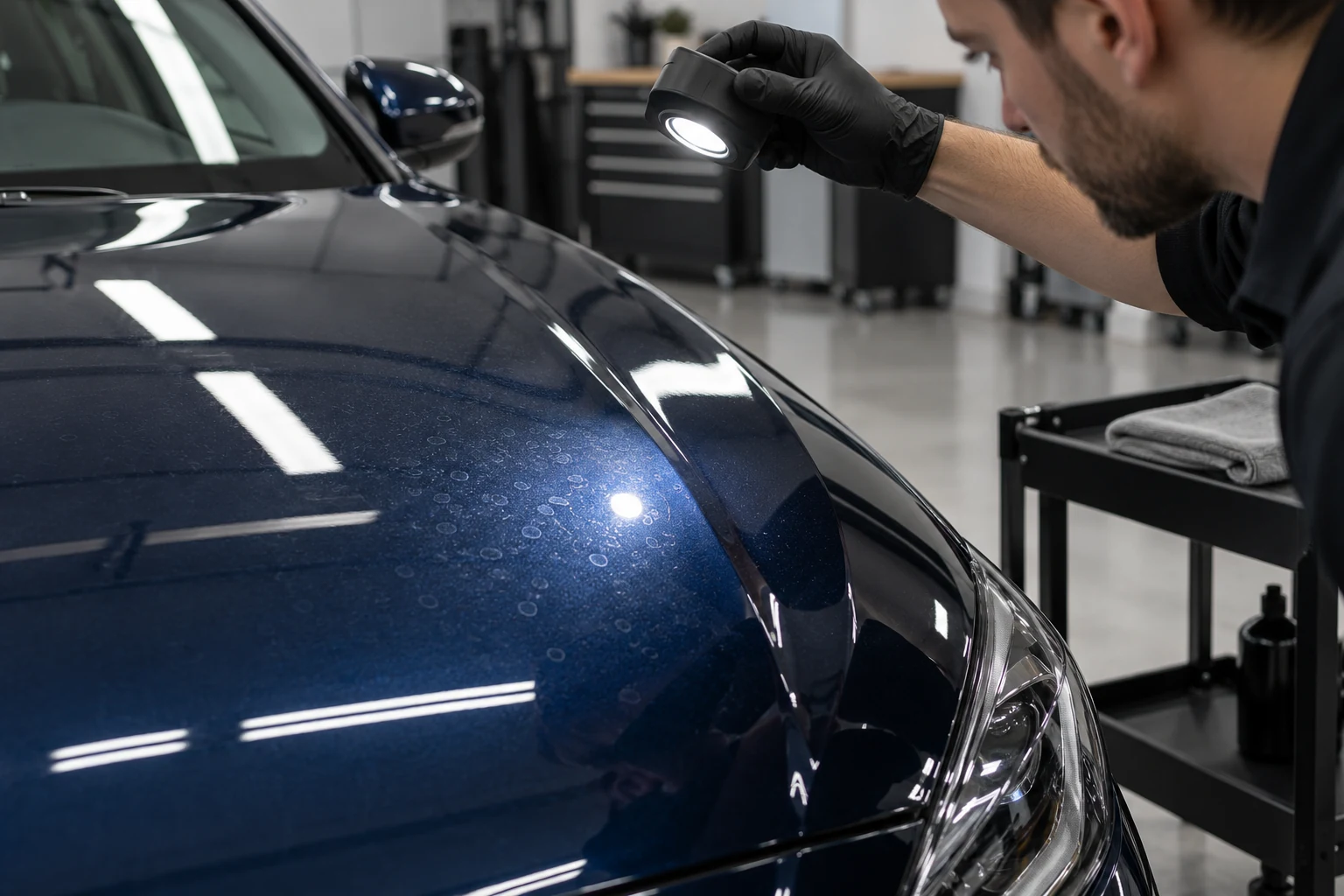
A chemical cleaner can remove suitable deposits. It cannot rebuild a surface that has been physically damaged. Gtechniq’s water-spot guidance distinguishes deposit removal from paint correction for etched clear coat.
On suitable glossy paint, a professional may consider controlled correction after inspection and a test area. Polishing can reduce or remove coating, and correcting clear-coat defects removes paint material. That makes it a separate decision from routine cleaning.
Agree the repair scope
Ask whether the proposed work concerns deposits, the coating layer or the underlying paint. Request the affected panels, expected improvement, defects that will remain and the protection to be reapplied. Matte paint needs its own finish-specific approach because ordinary gloss polishing can change its appearance.
Compare panel and whole-car work
A localized problem does not automatically justify correcting and recoating the entire car. Compare an assessed panel treatment with wider work only where the condition supports it. Conversely, treating one small visible ring may not solve widespread contamination. The inspection determines the useful scope.
Read our paint correction service for test-area decisions and paint-safety limits. Do not add a new layer of coating as a shortcut over unexplained spots. Establish what is present and prepare the surface appropriately first.
When removal of the final trace would require unjustified abrasion, accepting some remaining appearance may be the better choice. Ask the technician to explain that stopping point rather than judging the job by a promise that every mark will disappear.
Prevent recurring water spots
Review the parking position
Look at what happens between washes. Irrigation spray can repeatedly wet one side of a parked vehicle. Water retained around mirrors, handles, badges and trim can run onto a panel after the main surface has been dried. Moving a parking position or improving the drying routine may address the repeat pattern without another paid treatment.
Finish the drying routine
Wash when the panels can remain cool and products can be used as directed. Work within a manageable area so rinse water and shampoo do not dry while you are elsewhere on the car. Dry the finish gently with clean equipment and check for later drips after moving the vehicle.
Know the wash products
Ask a wash provider which shampoo, drying method and optional finishing products it uses. Explain the installed coating and any current restrictions. Declining an unidentified spray treatment keeps the maintenance history simpler when diagnosing a later change.
Check the rinse claim
If treated rinse water is available, ask what the wash provider actually supplies and maintains. Do not treat a “filtered” label as a promise that the car can be left to air-dry without deposits. Continue to follow the coating’s drying guidance.
Record recurring spots with the date and parking or washing conditions. A simple pattern over several exposures can be more useful than buying another cleaner each time. Report persistent recurrence to the installer with that history.
Manufacturer references
Product guidance checked October 9, 2026. Use the instructions for the actual coating, remover and surface.
Questions about stubborn spots on a coated car
Does rain always leave mineral water spots
No single water source explains every mark. Rain can interact with dirt already on the vehicle, and runoff or other contamination may contribute. Record the exposure and assess the clean surface instead of identifying the cause from the ring shape alone.
Can I use the same remover on the windows
Check the glass and any glass coating separately. A product may have different glass instructions or exclusions. Follow those exact directions and consider neighboring trim and paint rather than spreading the paint process to the whole vehicle.
Are spots after a new coating automatically a warranty claim
No. The installer needs to establish the cause and review the applicable terms. Send photographs, timing and care history promptly. Keep the surface available for inspection before using products that could alter the evidence.
Will adding a ceramic booster hide the problem
A maintenance product may change gloss or water behavior, but that does not show that the underlying deposit or defect has been removed. Diagnose persistent marks first and use only a booster approved for the existing coating.
How much does water-spot treatment cost
The useful scope may be a maintenance wash, compatible deposit removal or assessed correction with renewed protection. Ask for a quote that identifies the panels, method, expected limits and any recoating. A price without that distinction is difficult to compare.
Your next decision
Identify the coating, use its approved care and assess the dry result. Persistent marks call for a controlled test or inspection, not escalating pressure, improvised chemicals or automatic whole-car recoating.
Plan the next step
Have persistent marks assessed before authorizing correction
Start with the affected panels and photographs. Include the coating name, application date and products already used if you know them. Our Al Quoz team can discuss the appropriate inspection. Contact the original installer first when a fresh installation or existing warranty may be involved.