
Panel condition before wrapping
Will a Car Wrap Hide Dents and Dings?
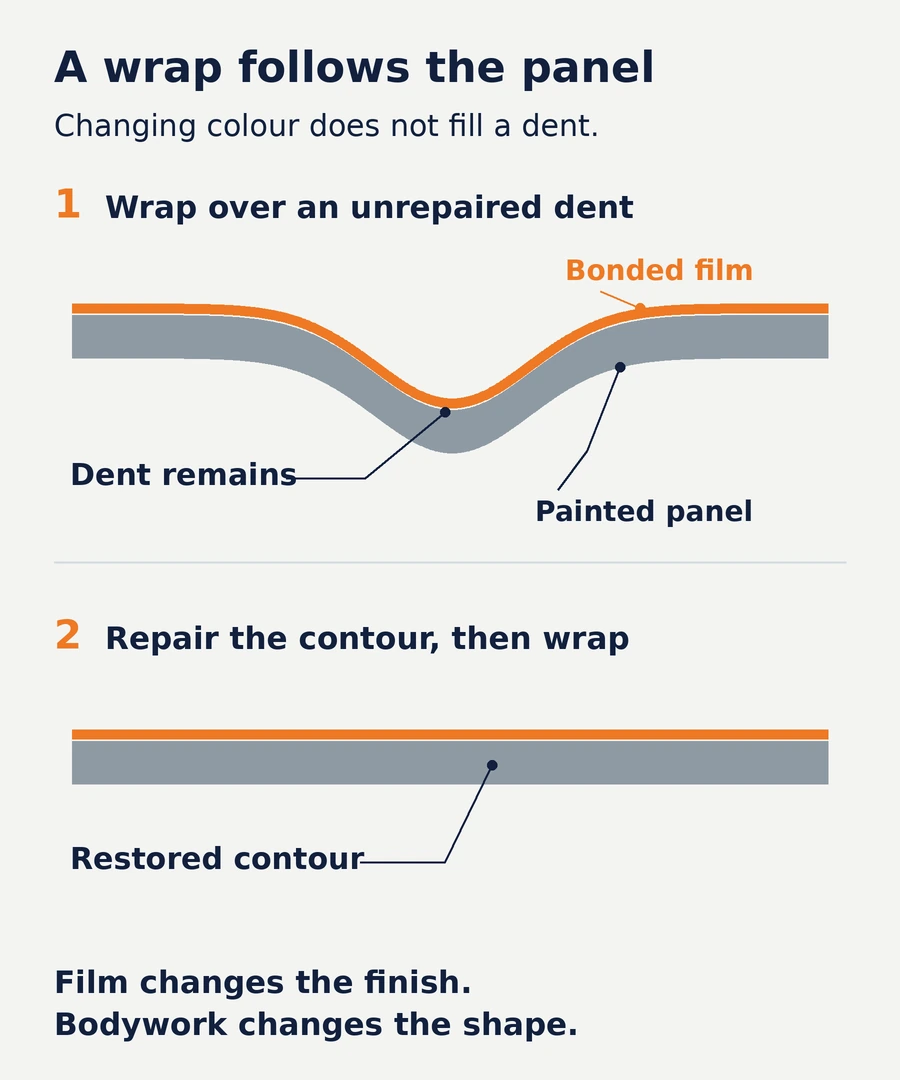
A car wrap changes the surface colour, but it does not fill a dent or straighten the panel. Dings and creases can remain visible through vinyl. For a smooth finish, assess the damage first, repair what needs attention and confirm that the paint is suitable for wrapping.
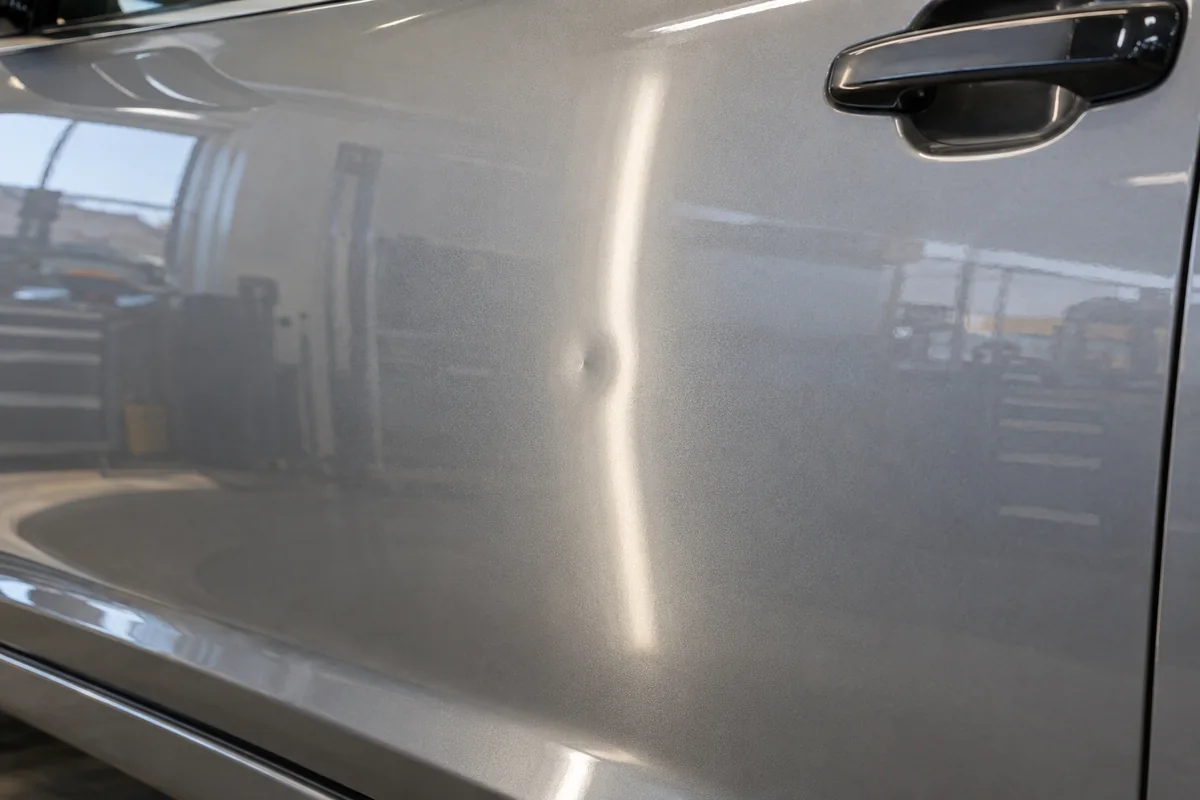
Separate a colour mark from a change in shape
An opaque wrap can cover the colour of a sound painted surface. That can change the appearance of a flat stain or an unwanted colour. A dent is different. The panel has moved inward, sometimes with a raised area around it. Covering that surface does not return the metal to its original shape.
Vinyl is applied in contact with the panel. It follows the underlying contour, including a depression or ridge. Pulling the film across a dent to leave an unsupported space is not a reliable cosmetic repair. It creates a fitting problem rather than a smooth, repaired panel.
| What you see | What wrapping changes | Useful next step |
|---|---|---|
| Flat colour mark on sound paint | Opaque film may cover the colour, subject to surface suitability | Check that the mark has no residue, raised edge or failing paint |
| Door ding with intact paint | The colour changes, but the depression remains | Assess paintless dent repair before fitting |
| Sharp crease, crack or deep chip | The shape or paint edge can remain visible | Agree the necessary bodywork and finishing |
| Rust or peeling clearcoat | Film does not repair the unstable surface | Resolve the paint or corrosion problem first |
| Distorted plastic bumper | Covering does not restore its shape or mounting | Have the bumper assessed using its repair requirements |
Scratches also need separating by condition. A mark that only changes colour is not the same as a groove, a chipped paint edge or exposed substrate. Do not assume that every scratch will disappear. The installer needs to inspect the texture and stability of the finish, not just whether an opaque film covers its colour.
3M’s 1080 and 2080 wrap-shop guidance warns that existing damage, including dents, can show through film. Its substrate requirements are a useful check against a promise that wrapping will make a damaged panel look new.
Assess the dent and the surrounding paint
Inspect a clean, dry panel in good light. Look from an angle as well as straight on. A reflection from a straight light or nearby edge can help reveal a change in contour. Move your viewing position rather than repeatedly pressing the damaged area. A photograph taken head-on can miss a shallow ding that becomes obvious from the side.
Take one wider picture showing the affected panel and a closer picture of the damage. Include a side view if it shows the depression more clearly. These pictures help explain the concern, but they do not establish the repair method or prove that the paint will tolerate adhesive and later removal.
- Location and shapeIdentify whether the damage lies in an open panel, on a body line, near an edge or beside a handle. A broad shallow dent and a short sharp crease can require different work.
- Paint conditionLook for a chip, crack, loose clearcoat or corrosion around the impact. Mention previous repainting and any repair that has already been attempted.
- Access and panel materialA technician needs to consider the panel construction and available access. External dimensions alone do not show the supports behind it.
There is no universal dent diameter below which vinyl makes damage invisible. Depth, the surrounding raised contour and the viewing angle matter too. Agree the intended result on the actual car. If the dent already bothers you, a new colour should not be treated as evidence that you will stop noticing it.
If an impact has also changed a door’s closing action, moved trim or damaged a mounting, describe that to the repairer. The assessment needs to address those problems as well as the visible depression.
Choose the finish without relying on it to hide the dent
Gloss, satin and matte finishes change how a panel reflects light. A glossy surface can show a dip through a distorted reflection. A less reflective finish changes that appearance, but the shadow and shape of the depression can still be visible. Neither finish restores the contour.
A printed pattern may make a small imperfection harder to pick out from one distance. That is a visual effect, not a repair. A close view, a different lighting angle or a plain section of the design may reveal it again. A stripe passing across the damaged area can also make an uneven line easier to notice.
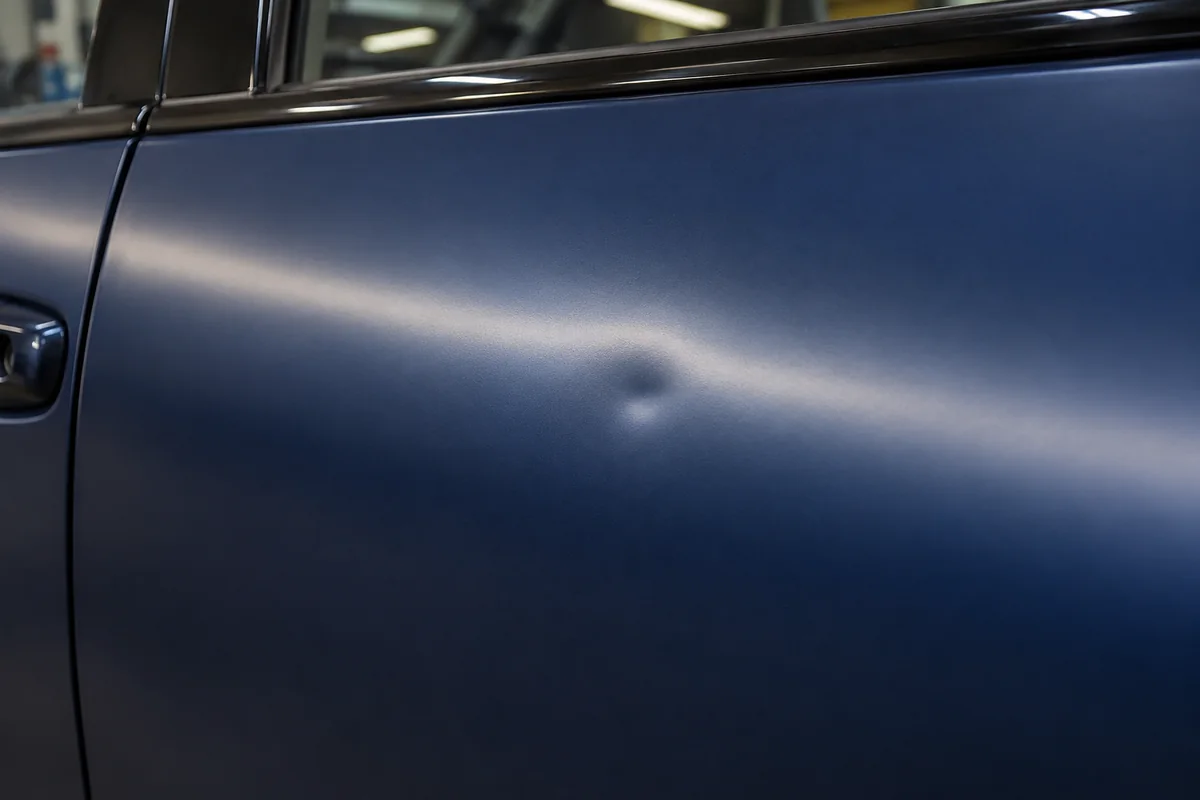
Ask to see a physical sample of the proposed film in daylight and workshop light. A flat swatch helps you choose the colour and sheen. It cannot demonstrate that the film will hide a dent on your door. Any proposed sample application should be agreed with the installer on a suitable surface, rather than used as an informal paint-adhesion test.
Keep two decisions separate. Choose the finish you want, then decide whether the remaining panel condition meets your expectations. Buying a textured, darker or thicker film solely to avoid repairing a visible ding can leave you with the same concern after fitting.
Consider paintless dent repair where the damage allows it
Paintless dent repair, often shortened to PDR, reshapes a suitable metal panel while retaining its existing paint. It can be worth assessing for a parking ding or suitable hail damage before a colour wrap. If the original finish can be retained, the job may avoid introducing a newly painted area solely to correct the shape.
The decision depends on more than whether a dent looks small. Paint integrity, the amount of deformation, panel access and the vehicle’s repair instructions all matter. A body-line dent is not automatically ruled out, and intact paint does not automatically make every impact repairable by PDR.
Steel and aluminium panels need assessment under their applicable repair limits. As a manufacturer-specific example, I-CAR’s summary of Rivian’s PDR instructions points to material restrictions and checks for paint micro-cracking. Those details should not be converted into one method for every vehicle.
Our paintless dent removal service explains the available assessment and repair scopes. Tell the technician that wrapping is planned so the recovered contour and paint condition can be checked before the vehicle moves to installation.
Ask what result is achievable. A complete contour correction, a partial improvement and a repair that requires refinishing are different outcomes. Do not approve a wrap on the assumption that it will conceal whatever remains after an incomplete repair.
The repair also needs to account for unseen surfaces. I-CAR’s guidance on corrosion protection after PDR explains that tools can disturb protective coatings behind the panel. Ask how any affected protection will be restored using the vehicle’s repair requirements.
Finish necessary bodywork before fitting the film
Cracked paint, a damaged panel edge, corrosion or deformation outside the permitted repair limits may need conventional bodywork. The repairer should decide whether reshaping, refinishing or replacement is appropriate. Filling a depression is not the automatic solution to every dent, especially where other damage needs investigation.
Do not apply vinyl directly over loose paint or use it to seal over rust. The adhesive needs a suitable bonded surface. Covering a defect can make inspection more difficult while leaving the underlying problem unresolved.
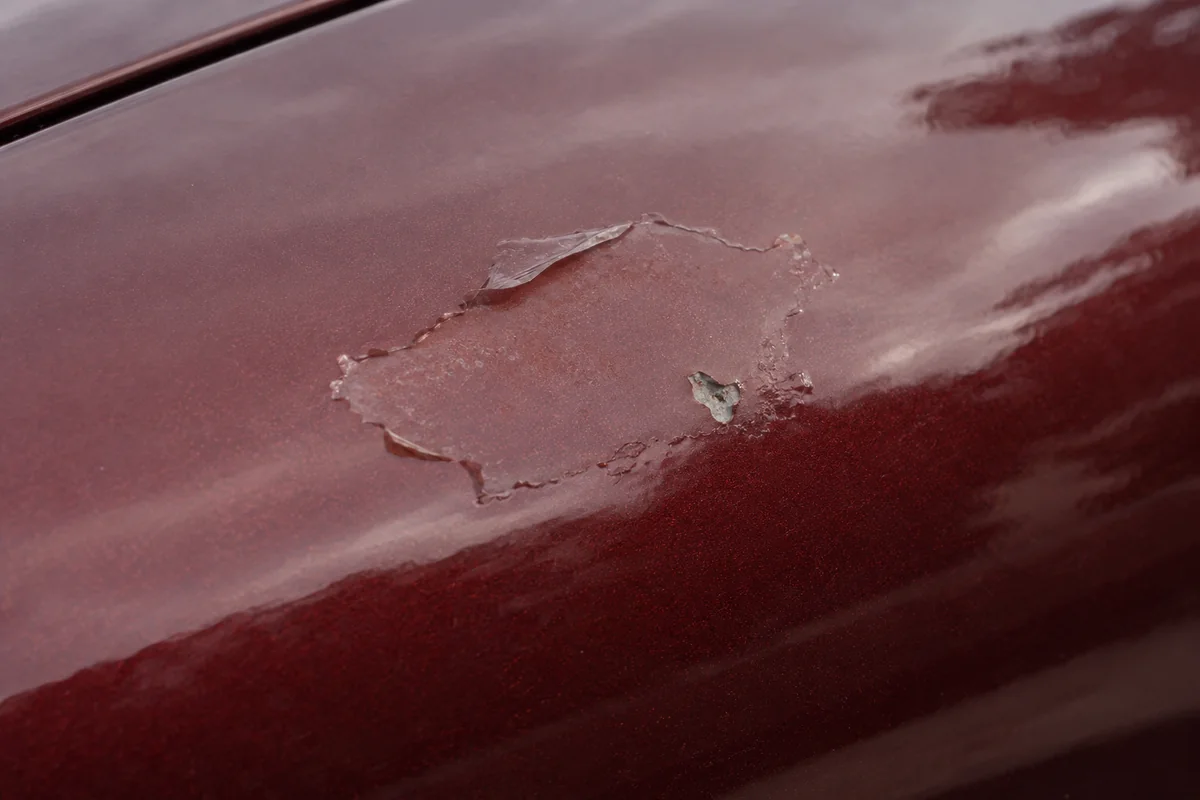
Where body filler is used, the repair must become an approved finished substrate. For its 1080 and 2080 films, 3M specifies preparation including epoxy primer and recommends an OEM paint or clearcoat finish for best results. Raw filler should not be treated as interchangeable with sound automotive paint.
Use the paint and film instructions to set the waiting time
A newly painted panel may feel dry before it is ready for wrapping. The paint system, application and drying process affect readiness. Ask the bodyshop to identify what was applied and when, and give those details to the installer.
Avery Dennison’s Supreme Wrapping Film application instructions require hardened paint and drying in accordance with the paint manufacturer’s directions. They warn that retained solvents can affect adhesion. Agree readiness for the actual paint-and-film combination instead of applying a universal waiting period to every repair.
Check the prepared panel before installation
After repair, review the shape under suitable light before it is covered. Point out any remaining ripple, sharp transition or visible repair boundary. The installer should know which imperfections were corrected and which, if any, you have agreed to leave. This is the point to resolve a disagreement about the expected finish.
Cleaning removes contaminants. It does not straighten a dent or make failing paint sound. Tell the team about wax, coatings, previous film and repair products so preparation can follow the selected material’s requirements. Avoid polishing, sanding or adding a dressing immediately before the appointment without agreeing it with the workshop.
During fitting, the installer plans contact, joins and finishing around the panel geometry. Heat makes compatible vinyl easier to handle within its instructions. It does not repair the metal underneath. Extra stretching is not a substitute for correcting a crease, and a bubble-removal tool cannot remove a dent.
A shallow depression with sound paint does not prove that film will immediately peel. Appearance, substrate suitability and application are separate considerations. Equally, a film warranty is not a promise that pre-existing damage will become invisible. Record any remaining defect and confirm how it affects the accepted installation and warranty scope.
If an installation cannot meet the film’s requirements, accepting a cosmetic compromise does not make the substrate suitable. Resolve the material or repair decision before proceeding.
Plan dent repair carefully on an already wrapped car
A new ding on a wrapped car may involve the film, the paint and the panel beneath it. A mark in the vinyl alone needs a different response from an impact that has moved the metal. Tell the repairer when the damage occurred and identify the film if possible.
Some repairs may be possible while retaining the film, depending on access, method and condition. Do not assume this is available for every dent. A wrap can obscure paint damage, while tools or pulling methods can disturb the finish. Agree whether removal is needed to inspect and repair the panel properly.
Ask whether the quotation includes removal and replacement of the affected film. A complete panel rewrap and a small patch have different join positions and appearance. If the repair requires trim removal, that work also belongs in the plan.
Keep the original film name, colour code and installation details. New material may look different beside an older exposed panel, even with the same product code. Directional finishes need orientation checks too. Review the replacement sample and the proposed panel boundaries before assuming the repair will be invisible.
Do not try to make the dent disappear by adding heat to the wrap. If the finish is torn, lifting or cracked around the impact, leave it for assessment. The repair decision should address the body damage first and then the condition of the film.
Compare the work included rather than treating a wrap as dent repair
A full wrap and a repair to one parking ding are different jobs. It is misleading to call wrapping the cheaper solution without comparing the actual scope. If your only concern is the dent, begin with a repair assessment. If you also want a colour change, assess preparation and wrapping together.
Ask for the dent repair, paintwork if needed, film removal and new installation to be identified separately. A quote should name the panels included, access work, film product and agreed result. Confirm the VAT-inclusive total and any exclusions before authorising production.
The timing follows the same distinction. A repair that retains sound paint has a different handover process from one that needs refinishing and a curing period. Confirm the order of work rather than relying on a generic promise that any damaged car can be wrapped in a day or two.
Check contour and finish at handover
Inspect the completed panel from normal viewing distance, then move closer and look along it from both directions. Use the agreed pre-work photographs to locate the original damage. Check for a remaining depression, distorted reflection, raised paint edge or conspicuous repair boundary.
Also review film contact, joins and the appearance beside neighbouring panels. A wrap with neat edges can still have an unrepaired dent beneath it. A repaired contour can still need attention if the new film does not match the accepted finish. Keep the bodywork result and installation result distinct when discussing a concern.
Retain the repair record, film identification and care and warranty instructions. If the area later lifts or changes shape, send photographs and arrange an inspection rather than pressing, puncturing or heating it repeatedly. Note whether the change followed a new impact.
Future removal also needs the paint history. Repaired or poorly bonded paint can lift when adhesive film is removed, so removal without damage should not be promised for every substrate. Tell the next installer about the work beneath the wrap. A good-looking colour change does not erase that history.
Check the panel before choosing the finish
Send the dent and a wider panel view
Share your vehicle details, clear photos and any paint-repair history. Our Al Quoz workshop can discuss whether a dent assessment, paintwork or wrap preparation is the appropriate next step.
Common questions about wrapping over dents
Will a matte wrap hide a door ding?
Matte changes the reflection, but the underlying depression remains. Its visibility depends on the shape, lighting and viewing angle. Choose the finish for its appearance and assess the dent separately.
Is a thicker wrap a substitute for body filler?
No. An adhesive film is not a material for restoring the panel contour. Adding film layers does not establish a sound body repair and can introduce unwanted edges or fitting problems.
Can hail dents be wrapped without repair?
Multiple depressions can remain visible across the bonnet, roof and other panels. Have the damage assessed first, including paint condition and repair suitability. Wrapping does not reverse hail damage.
Does a nail catching in a scratch mean wrapping is impossible?
It indicates texture that needs inspection, rather than giving a complete diagnosis. The depth, paint edge and substrate condition matter. Avoid scraping the area or assuming a home test establishes repair or film suitability.
Will PPF prevent or repair parking dents?
Paint protection film is intended for specified surface-protection uses. It does not straighten an existing dent or guarantee that an impact cannot deform the panel. Select protection for its documented scope.
Can I leave one small ding unrepaired?
Discuss it with the installer if the dent does not concern you. The surface must still meet the film’s requirements. Record the remaining damage and expected appearance instead of assuming the wrap will conceal it.