
Glide, grip and clean film contact
Best Gloves for Car Wrapping by Task
For smoothing vinyl by hand, start with a clean, snug, seamless application glove that glides without shedding fibres. Purpose-made cotton and synthetic wrap gloves can both work. A rubber-coated grip glove serves a different task, while chemical preparation and heat hazards require separately suitable protection. Test your glove on the actual film before touching the car.
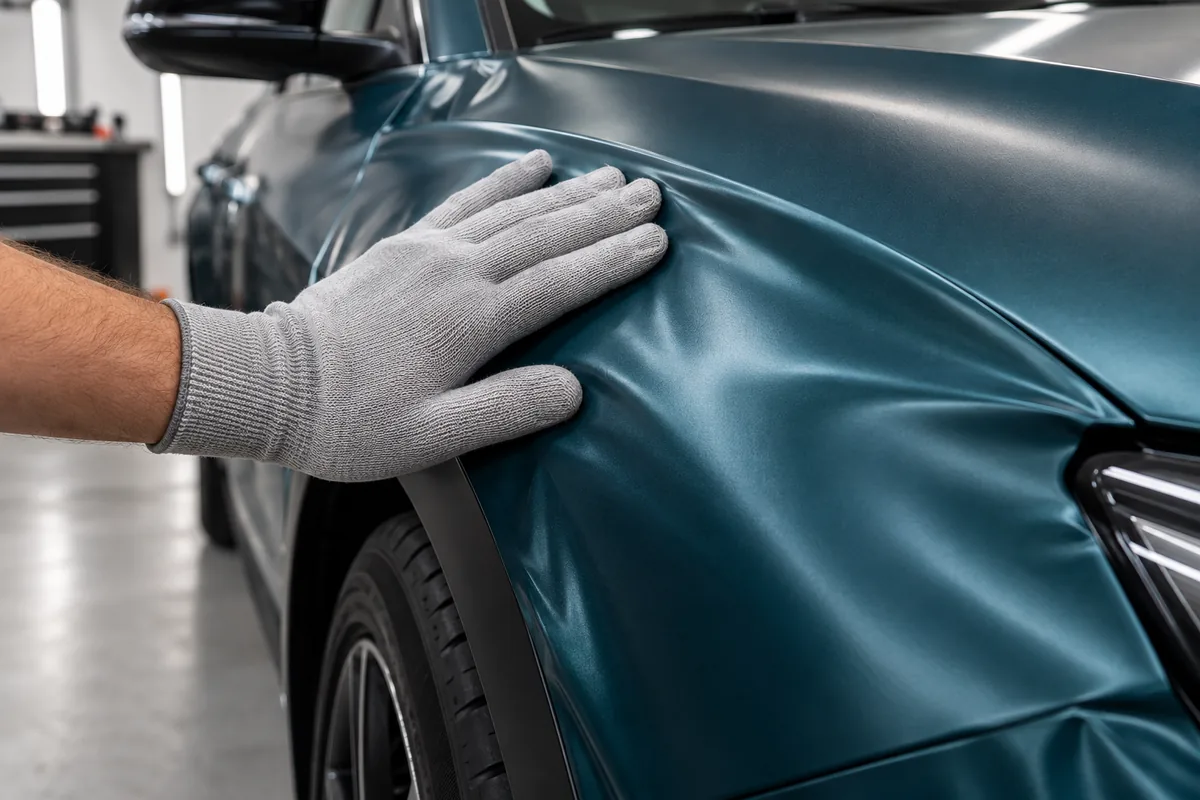
Choose glide for smoothing and grip for holding
Your hand does two different jobs during wrapping. It may hold a loose sheet steady, then move over the face of the vinyl to guide it around a contour. Strong grip can help with the first task and hinder the second. A glove that catches the surface makes a smooth stroke difficult, even when it feels comfortable.
For film-face contact, look for a fine, even knit, low drag and a fingertip shape that stays close to your hand. These features matter more than a professional-looking colour or a thick palm coating. A purpose-made application glove can turn the fingers into a flexible contact surface where a broad squeegee cannot easily reach.
The glove does not replace the film’s application method. Use the appropriate buffered squeegee and required pressure to establish adhesion. Do not assume a gentle finger pass has completed a large panel or bonded a deep recess correctly. The glove helps you control contact, while the film instructions determine the fitting sequence.
If you need a firmer hold on a loose edge, consider how to support the sheet before simply pulling harder. A better glove cannot make excessive stretching suitable for the material. Our guide to building a car wrap tool kit places application gloves alongside sheet support, applicators and temperature measurement rather than treating them as a complete installation solution.
Compare the contact surface, not just the fibre
Cotton versus coated is an incomplete comparison. Cotton describes a fibre. Coated describes a treatment that could increase grip or improve sliding. A smooth synthetic application glove and a rough rubber-dipped work glove should not be grouped together simply because both have a treated surface.
| Glove type | Useful role | Check before use |
|---|---|---|
| Purpose-made cotton | Soft hand contact while guiding vinyl | Fit, loose fibres and drag on your film |
| Synthetic application glove | Controlled sliding and contour work | Actual construction, finish compatibility and care instructions |
| Rubber-coated grip glove | Holding suitable loose materials or equipment | Coating texture, residue and suitability for the specific task |
| Chemical protective glove | Preparation with a named cleaner or remover | Product safety sheet and glove resistance data |
Ordinary cotton inspection gloves may have bulky seams or shed fibres. Conversely, a purpose-made cotton application glove can suit curved areas. There is no dependable rule that reserves cotton for flat bonnets and coated gloves for bumpers.
Likewise, a nitrile-coated palm on a knitted work glove is different from a full disposable nitrile glove. Neither description establishes that the glove will glide over vinyl, withstand a particular solvent or protect against a hot nozzle. Identify the actual product and its intended use.
Useful wrap gloves to compare
These named options provide clearer starting points than an unbranded listing promising grip, heat resistance and a flawless finish. Their published descriptions identify different constructions or handling features. Choose according to the film and task, then confirm the exact variant with the supplier.
Avery Dennison cotton application glove
Avery Dennison describes its cotton application glove as soft and seamless, for smoothing graphics into curves and recesses. It is a sensible option to compare when you want a straightforward textile glove for hand application. The manufacturer’s description also identifies anti-static properties, which should not be assumed for every cotton glove.
Yellotools YelloGloves
YelloGloves use a seamless nylon construction with a stable cuff. They are worth considering when you want a synthetic application glove rather than cotton. Check the available size and how the fingertips sit on your own hand. Seamless construction is useful, but loose fabric can still interfere with a precise stroke.
Yellotools GloveMaxx ProWrap
GloveMaxx ProWrap is designed around low-friction sliding. Its manufacturer permits machine washing up to 40°C and explicitly excludes use where chemical, electrical or thermal risks are present. That makes the handling feature and protection limit clear. Consider it for film-face movement, with separate protection for other workshop hazards.
WrapGlove V3 Original
The V3 Original has reinforced fingertips and a seamless body, with four published sizes. WrapGlove describes it as lint-free and static-resistant, and advises a cold wash and line drying for an already snug fit. It is an option to compare when fingertip wear, sizing and reusable construction are priorities.
None of these examples establishes a universal winner. Manufacturer descriptions are useful selection information, while your scrap-film test checks the actual glove in your working conditions. Different versions from the same brand can also have different sizing and care requirements.
Check fit with your hand open and bent
A wrap glove should stay close to the fingertips without making a fist uncomfortable. Excess material at the end of the index finger can fold under pressure. A tight glove can restrict movement and pull away from the spaces between the fingers. Both problems make small edges harder to feel.
Use the product’s size chart rather than assuming your usual work-glove size transfers across brands. Measure in the way the manufacturer specifies. Try the glove with your hand open, fingers spread and fingers bent, since a comfortable resting fit may change when you reach around a mirror cap.
- FingertipsNo loose pocket of fabric beneath the finger you use for finishing.
- PalmNo thick fold where you press or guide the film.
- CuffStays in place without repeatedly pulling the glove off your hand.
- MovementComfortable reach and bend without forcing your fingers against the fabric.
Check the seams and any printed area as well. A cuff logo is different from a raised treatment on the fingertips. Judge the part that will actually touch the vinyl. If you use a finger sleeve instead of a full glove, keep the uncovered hand away from adhesive and remember that only the covered area has the chosen contact surface.
Test gloss, matte and textured films separately
Do not choose a glove solely from the finish name. Two gloss films can have different surface behaviour, and a glove that slides easily on one may drag on another. Use an offcut from the actual roll, with any protective surface layer handled according to that film’s instructions.
Gloss and reflective surfaces make fine marks easier to see under directional light. Matte and satin finishes can show changes in sheen where pressure or rubbing affects the face. Textured vinyl can catch loose fibres. These are reasons to check your contact method, rather than automatic instructions to use cotton, coated or thicker gloves.
Use enough pressure for the intended step without repeatedly scrubbing the same point. If a finger catches, stop and inspect the glove and film. Increasing force can turn a handling problem into a visible mark. A clean replacement glove or a suitable finishing tool may be the better next step.
PPF is a separate material and workflow. Some application gloves are sold for vinyl, PPF and tint, but that does not make their installation liquids or techniques interchangeable. Choose for the named product. Do not spray a dry colour-change wrap with water merely because a glove listing also mentions wet PPF work.
Run a scrap-film test before touching the car
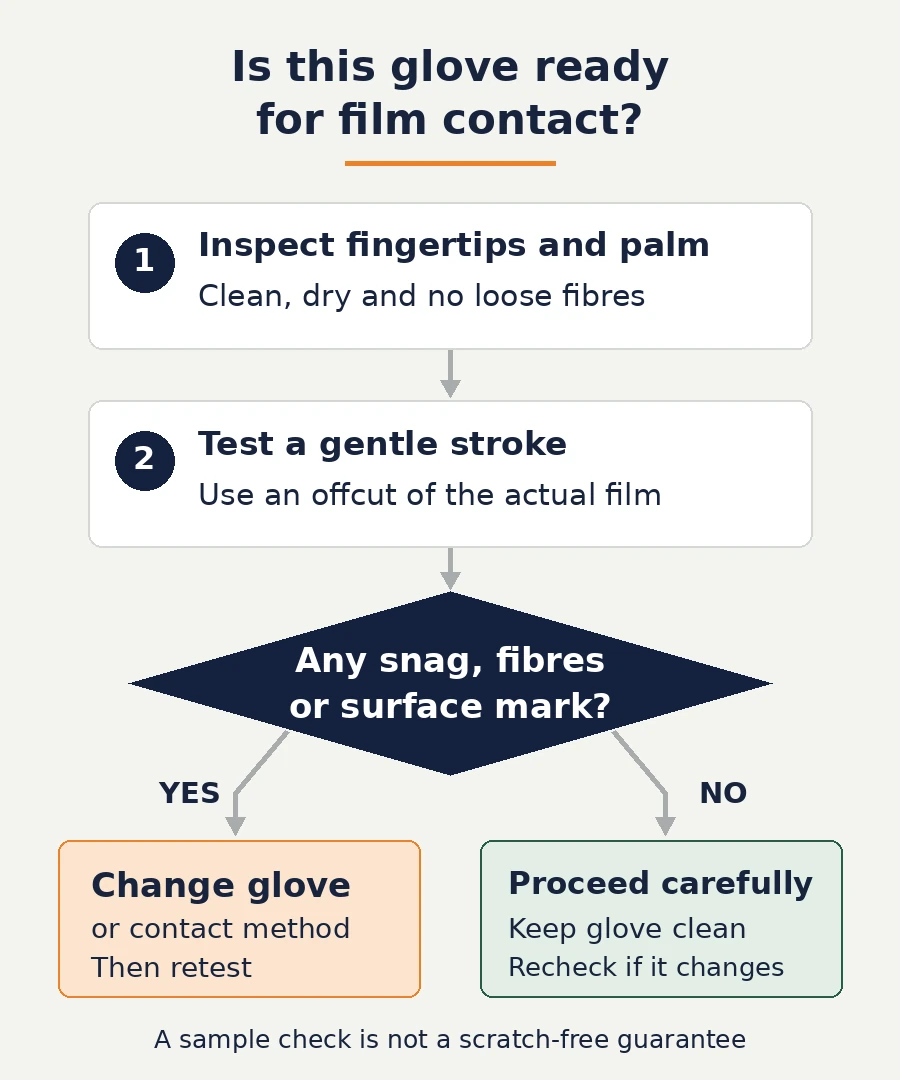
A small sample helps you judge whether the glove fits, slides and stays clean without risking a finished vehicle panel. It is a practical screening check, not a laboratory proof that the glove cannot scratch any film. Repeat it when the film, glove or washing routine changes.
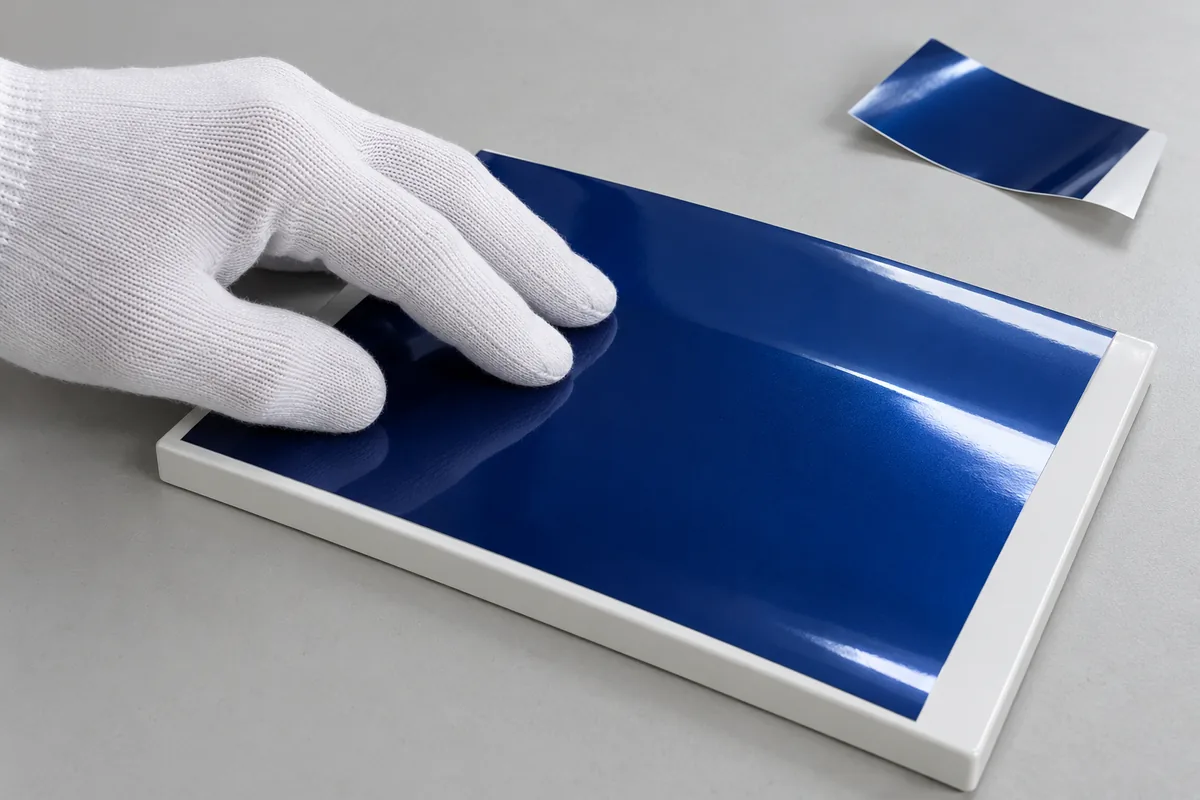
- Inspect the glove. Check fingertips and palm for dirt, hardened adhesive, loose fibres and coating damage. Start with a clean, dry glove.
- Prepare a representative sample. Fit an offcut to a smooth suitable test surface using the film’s normal application method.
- Make a controlled stroke. Use the finger contact and movement intended for the job. Do not rub aggressively to manufacture a test result.
- Look in changing light. Inspect the sample from more than one angle for streaks, fibres, surface marks or altered sheen.
- Check the glove again. Look for pilling, transferred material or a fingertip that has folded during the stroke.
- Decide before continuing. If the glove catches or leaves a mark, change the glove or contact method and test a fresh area.
Compare candidates on separate sample areas with the same film and similar movements. Testing one glove lightly and another with heavy pressure tells you little about their suitability. Include a small curved sample if your work involves contouring, since a flat stroke does not test how loose fingertips behave around a return.
Keep chemical preparation separate from film contact
Do not clean panels with bare hands simply to keep an application glove free of dirt. Choose protective gloves from the cleaner’s safety data sheet and the glove manufacturer’s compatibility information. The required material, thickness and change interval depend on the chemical and the expected contact.
HSE’s glove-selection guidance explains that no glove material protects against every substance and that chemical resistance depends on the specific glove. A box labelled nitrile is therefore not enough information for every adhesive remover or preparation solvent.
Remove preparation gloves appropriately after the cleaning stage, clean and dry your hands, and put on the clean application glove when the panel is ready. Do not use the same textile glove to hold a wet cleaning cloth and then smooth the film. Keep used cloths and contaminated protective gloves away from the clean supply.
The same separation matters after touching a door hinge, dusty trim, a phone or the floor. Check the film-contact glove before resuming. Our surface preparation guide covers the cleaning sequence and tool choices in more detail.
A wrap glove is not automatic heat or cut protection
Soft fabric and a rubber-coated palm do not establish thermal protection. Only use a glove for a heat hazard when its documented protection is suitable for that task. A glove intended to slide over vinyl should not be used to test the temperature of a nozzle or heated panel with your fingers.
Keep the heat-gun outlet away from your hand and give the tool a safe resting position. Use an appropriate surface thermometer and the film’s fitting instructions. The temperature selected on the heat gun is different from the temperature reached by the vinyl, so a single outlet-temperature threshold is not a safe rule for hand contact.
Cut protection is separate too. Reinforced fingertips or a general durability claim are not proof that a glove will stop a blade. Keep your supporting hand out of the cutting path and use a suitable cutting surface for loose sheets. Follow the task’s protective-equipment requirements without sacrificing a safe cutting method.
If the glove that provides the required protection is unsuitable for touching the film face, change the work sequence or contact tool. Trying to make one glove perform every task can compromise either handling or protection.
Wash by the product instructions and replace by condition
There is no useful universal replacement rule such as two or three full wraps. One glove may become contaminated during the first panel, while another remains serviceable after washing. Inspect condition before use and whenever the contact changes.
Follow the care instructions for the exact glove. GloveMaxx ProWrap permits washing up to 40°C, while the V3 Original’s snug-fit advice is a cold wash and line drying. Those instructions should not be transferred to every coated glove. Check detergent, drying and other restrictions on the supplied label.
Keep film-contact gloves separate from oily rags and chemical-contaminated items. After washing, let them dry as instructed, check the fit and repeat the sample test. Do not assume a washed glove retains its earlier sliding behaviour. A changed texture, stiff patch or shedding fingertip needs attention before the next panel.
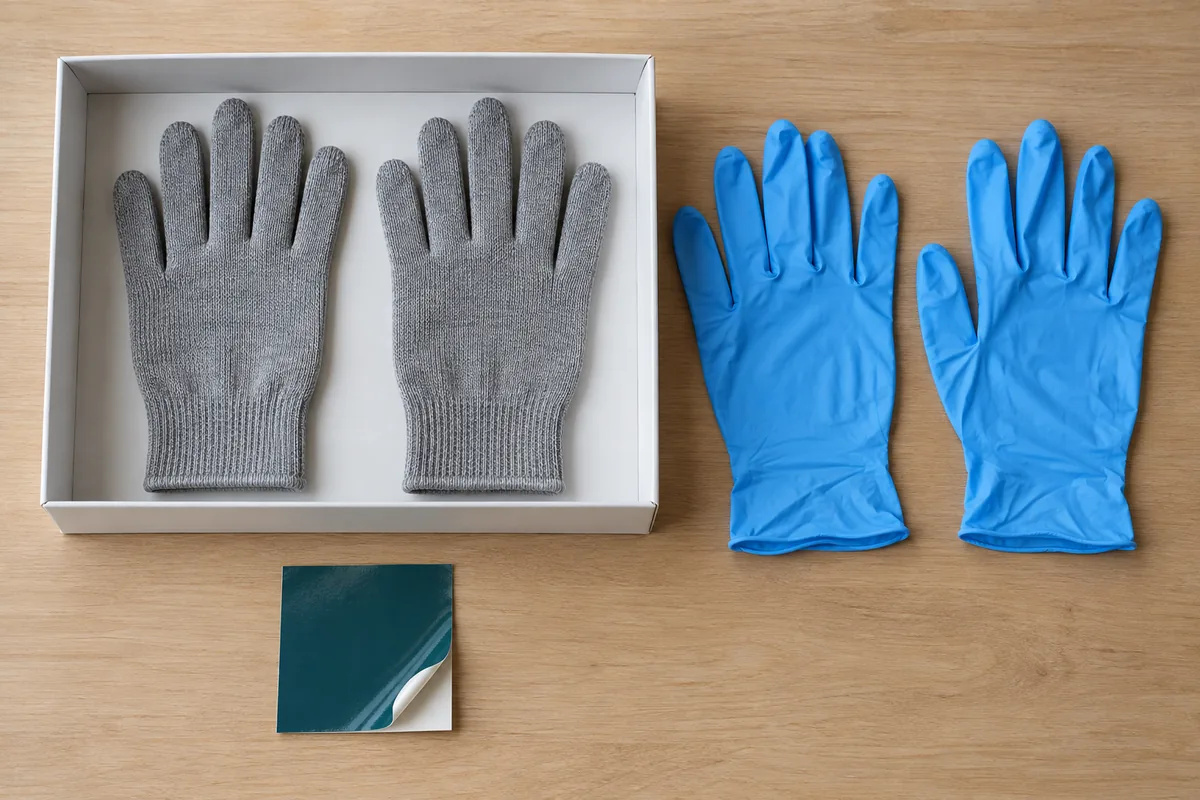
Replace a glove when it has embedded grit, persistent adhesive, holes, loose threads, damaged coating or a fit that no longer stays controlled. Keep clean spares ready in a closed container so changing gloves is easy. A new glove also needs inspection before first use.
Buy a usable set rather than the cheapest listing
Before ordering in Dubai, confirm the product name, size, quantity and care information. Some specialist application gloves are sold individually and fit either hand. A single-glove price should not be compared directly with the price of a pair or a multipack.
Ask whether the listing describes a low-friction application glove or a high-grip work glove. Check photographs of the palm and fingertips, not just the logo on the back. A material description and a clear intended use are more informative than claims that the glove is suitable for all automotive work.
Compare the delivered total, including shipping and the stated VAT treatment. Overseas product prices do not establish a local retail price or local availability. Confirm stock, the return terms for sizing and whether replacement singles can be bought before ordering a large quantity.
For a first purchase, a suitable application glove with a clean spare is more practical than several unfamiliar types. Add separately specified preparation gloves for the products you use. In a warm workshop, rotate a damp application glove for a dry one and take breaks when needed. Breathable fabric does not keep hands dry indefinitely or make a hot working area suitable for the film.
Common questions about wrapping gloves
Can a cotton glove be used around a mirror cap?
Yes, if it is a suitable application glove that fits and moves cleanly on that film. Cotton is not restricted to flat panels. Check fingertip folds and drag on a representative sample first.
Are anti-static gloves also electrical safety gloves?
No. A static-resistant application glove does not establish electrical protection. Treat the feature as a product-specific handling property and use separately suitable protective equipment for electrical hazards.
Can I wet a wrap glove to make it slide?
Only when the named film and glove instructions allow that method. Do not introduce water or an improvised lubricant into a dry vinyl application because another product uses a wet PPF process.
Are powder-free disposable gloves a replacement for wrap gloves?
Not automatically. They may suit a preparation task when their chemical resistance is appropriate, but their surface can drag during vinyl smoothing. Choose film-contact handling separately and test it on an offcut.
Does a more expensive glove prevent bubbles?
No. Air release and adhesion depend on the film, preparation, application method and pressure. A glove can improve hand control but cannot compensate for trapped contamination or an incorrect fitting sequence.
Can I keep using a glove after dropping it?
Remove it from film contact and inspect it. If grit or contamination cannot be reliably removed, use a clean spare. Do not brush it once and assume the fingertips are suitable for a visible panel.
Plan the finish before fitting
Discuss the film and finish for your car
Share your car model and the colour or finish you have in mind. Our Al Quoz workshop can discuss the material, panel coverage and fitting scope for your wrap.