
Color and finish choices
Car Wrap Colors and Finishes
Start with a color family, then compare the finish on a physical sample. Silver and gray offer a restrained look, blue and green add depth, and red or bronze creates a stronger contrast. The best choice is the one you still like beside your own car in daylight.
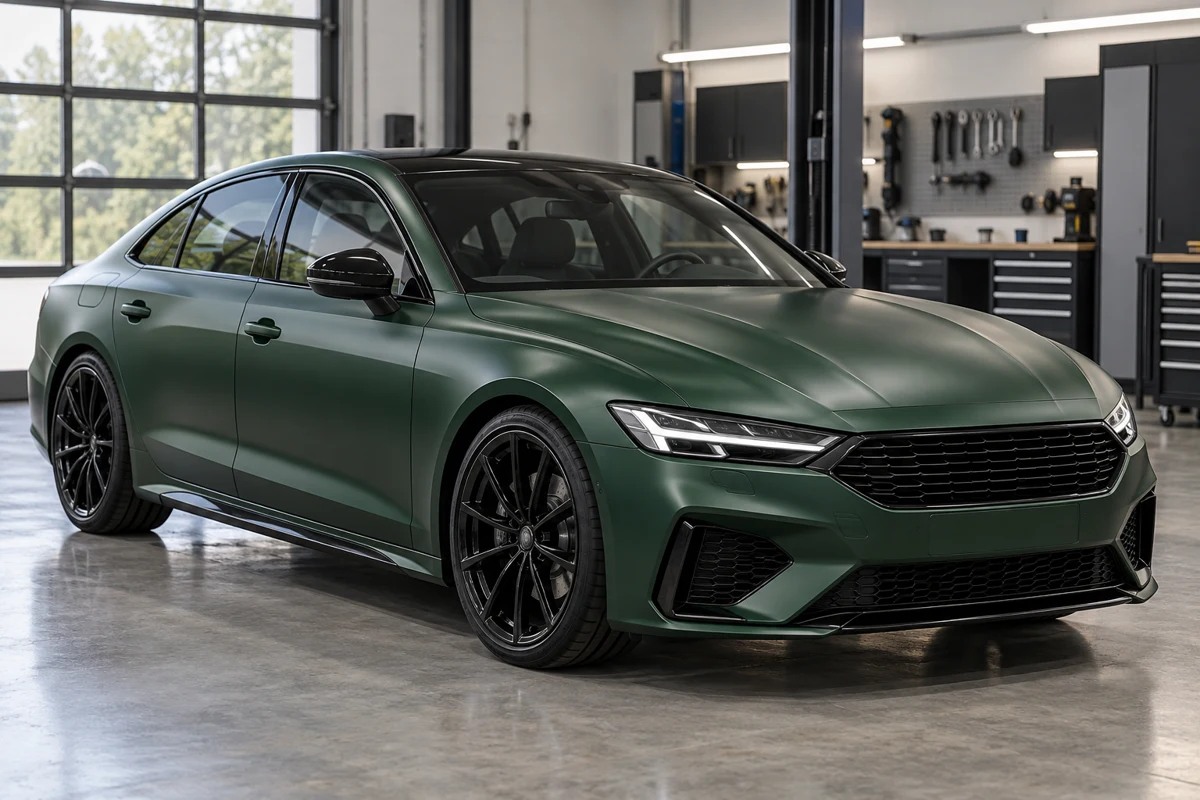
Build a shortlist from these color families
Choose two or three candidates rather than trying to compare every swatch at once. A useful shortlist contains a familiar option, a more expressive alternative and, if needed, a compromise between them. Compare the same finish first so the surface sheen does not distract from the color.
| Color family | Starting point | Check beside the car |
|---|---|---|
| Silver and light gray | A restrained change | Warm or cool undertones beside wheels and trim |
| Graphite and black | A darker silhouette | Whether black details blend into the bodywork |
| White and pearl | A bright finish | Any original white paint left in door openings |
| Blue and teal | Visible color with depth | The shade in direct light and shadow |
| Green and olive | Deep or earthy tones | Blue or yellow undertones and the wheel finish |
| Red and burgundy | A stronger color statement | Rear lights, calipers and colored badges |
| Champagne, bronze and sand | A warmer neutral palette | Actual sheen and reflectivity, beyond the color name |
Silver and light gray for a restrained change
Silver works well when you want the car to look different without making its color the main feature. Metallic silver has sparkle and light variation. A solid pale gray gives a flatter, more uniform color. Both deserve checking beside your wheels and window trim because a warm silver and a cool gray can create quite different combinations.
Compare a light sample with a medium gray before deciding. A tiny swatch can make the paler option seem almost white, while a larger curved sample reveals more of its tone. Silver is a styling choice, not a guarantee against dirt, fading or visible damage.
Graphite and black for a darker silhouette
Gloss black gives strong reflected highlights. Satin black keeps a softer sheen, while matte black reduces the shiny appearance further. Graphite offers another route if you like dark colors but want clearer contrast against black trim. Look at all of them in shade as well as direct light.
A black-on-black combination can make the wheels, mirrors and body blend together. That may be the effect you want, but check a photograph of the whole car rather than deciding from the hood alone. Ask how the selected finish should be washed before accepting its care requirements.
White and pearl for a bright finish
Solid white, ivory and pearl white are separate choices. Put the samples together and the differences become clearer. A pearl effect changes the light response, while ivory introduces a warmer base tone. Compare each beside any existing white paint that will remain exposed.
If door openings are excluded from the wrap, the original color will still appear when the doors open. A new white that nearly matches the factory white can make that difference more noticeable than a deliberate contrast. Agree which areas will be covered before choosing a near-match.
Blue and teal for a distinctive everyday color
Deep blue can appear close to black in shade and much brighter under direct light. A mid-blue holds more visible color across a wider range of lighting. Teal adds a green influence, so it needs checking beside silver, chrome and black details rather than being judged as just another blue.
Metallic and pearl versions add another variable. Move around the sample and compare its face with the darker edge. If you prefer a consistent color rather than a changing effect, start with solid blue samples and introduce special finishes only after that comparison.
Green and olive for depth or an earthy tone
A dark forest green, a bright metallic green and a muted olive create different results. Dark green is worth comparing with deep blue if you want color that becomes more visible in light. Olive and sage belong to a softer palette and can pair neatly with black trim or warm wheel finishes.
The green on a screen may look bluer or yellower than the physical film. Place the sample beside the car and inspect it without a phone camera between you and the surface. Avoid approving a shade solely because it looked good on another vehicle with different wheels and proportions.
Red and burgundy for a stronger color statement
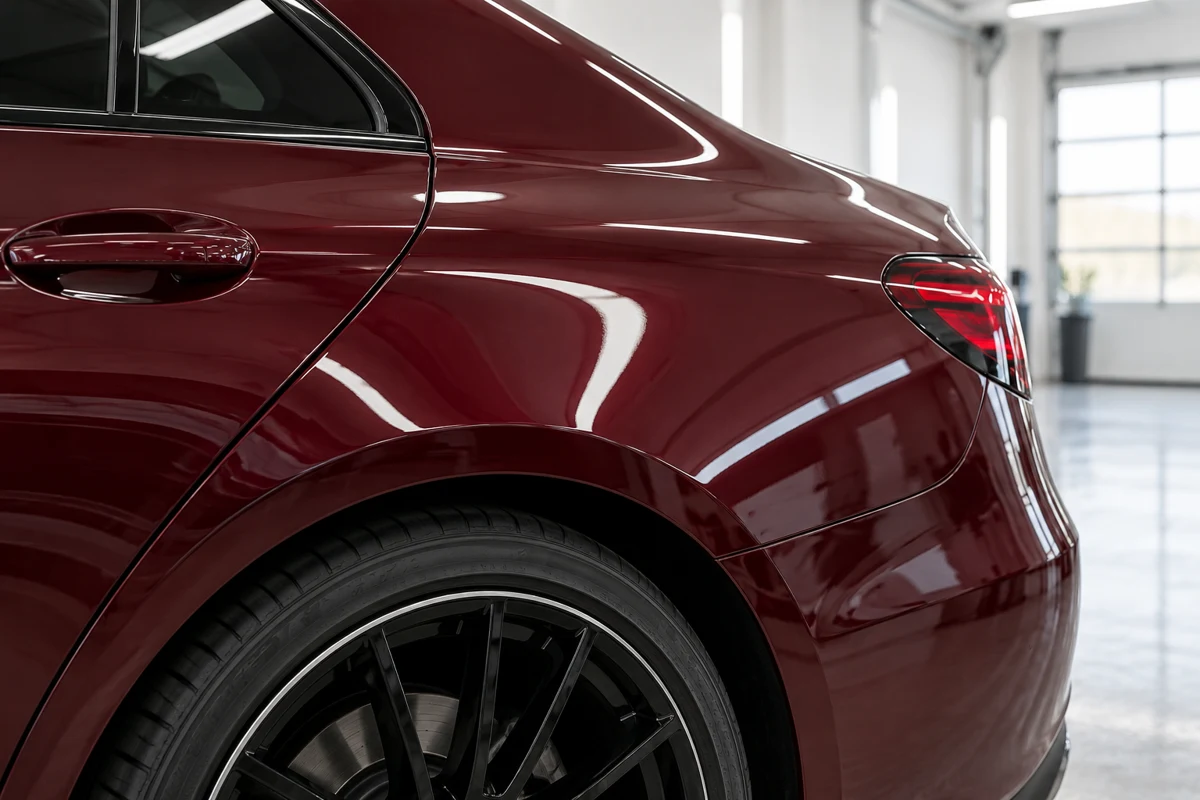
Bright red puts the color at the center of the design. Burgundy and darker reds offer a more subdued alternative, especially in shade. A metallic red can have a different depth from a solid red even when their names sound similar. Compare them in the same light before selecting one.
Check the shade beside rear lights, brake calipers and any colored badges that will remain. Several almost-matching reds can look less deliberate than one clear main color with neutral accents. You do not need to replace those details, but they should be part of the color decision.
Champagne, bronze and sand for a warmer palette
Warm neutrals are useful if gray feels too cool. Champagne may sit close to silver in some lighting, while bronze introduces more visible brown or copper. Sand and beige usually provide a quieter solid-color option. Compare their undertones beside the vehicle's wheels and chrome.
Metallic bronze is different from mirror chrome gold. The color name alone does not tell you how reflective the material is. Ask to see the actual film and identify its finish. A warm shade can be subtle or conspicuous depending on sheen, panel size and surrounding details.
Pink, orange, yellow and purple are valid options if you want a stronger departure from the factory color. Use the same sample checks rather than treating them as temporary fashions. Choose a shade you enjoy in everyday use, rather than buying it simply because it appears in a top-ten list.
Choose the color and surface finish together
Finish describes how the surface handles reflections. Metallic and pearl describe effects within the color. They are not competing categories, so a film can be satin metallic or gloss pearl. Ask for the complete product name rather than approving only “green” or “satin”.
| Finish or effect | Appearance to inspect | Question before choosing |
|---|---|---|
| Gloss or high gloss | Clear reflected highlights and surface texture | Do you like the reflection across a curved panel? |
| Satin | A soft sheen between gloss and matte | Does it show the body lines as you want? |
| Matte | A low-shine surface | Can you follow the film's cleaning restrictions? |
| Metallic or pearl | Sparkle, undertone and changes with angle | Has installation direction been planned? |
| Color flip | Different apparent colors as the view changes | Do you like every visible part of the color range? |
| Mirror chrome | A strongly reflective surface | Has suitability and approval been checked for the exact design? |
For a near-factory appearance, inspect a gloss sample over a curve and look at the quality of the reflected lines. For a softer result, compare satin and matte in identical lighting. Neither is automatically more premium or more durable. The named product, application and care requirements still matter.
If you want a color-flip finish, inspect its full range of visible colors. For printed artwork, review the layout as well as the palette. Establish whether you prefer neutral, warm or cool tones before comparing those more complex designs.
Check physical samples beside your own car
Digital images help narrow the search, but they cannot approve the production color. Avery Dennison's Supreme Wrapping Film range recommends using its physical swatchbook because lighting and viewing angle affect the digital comparison.
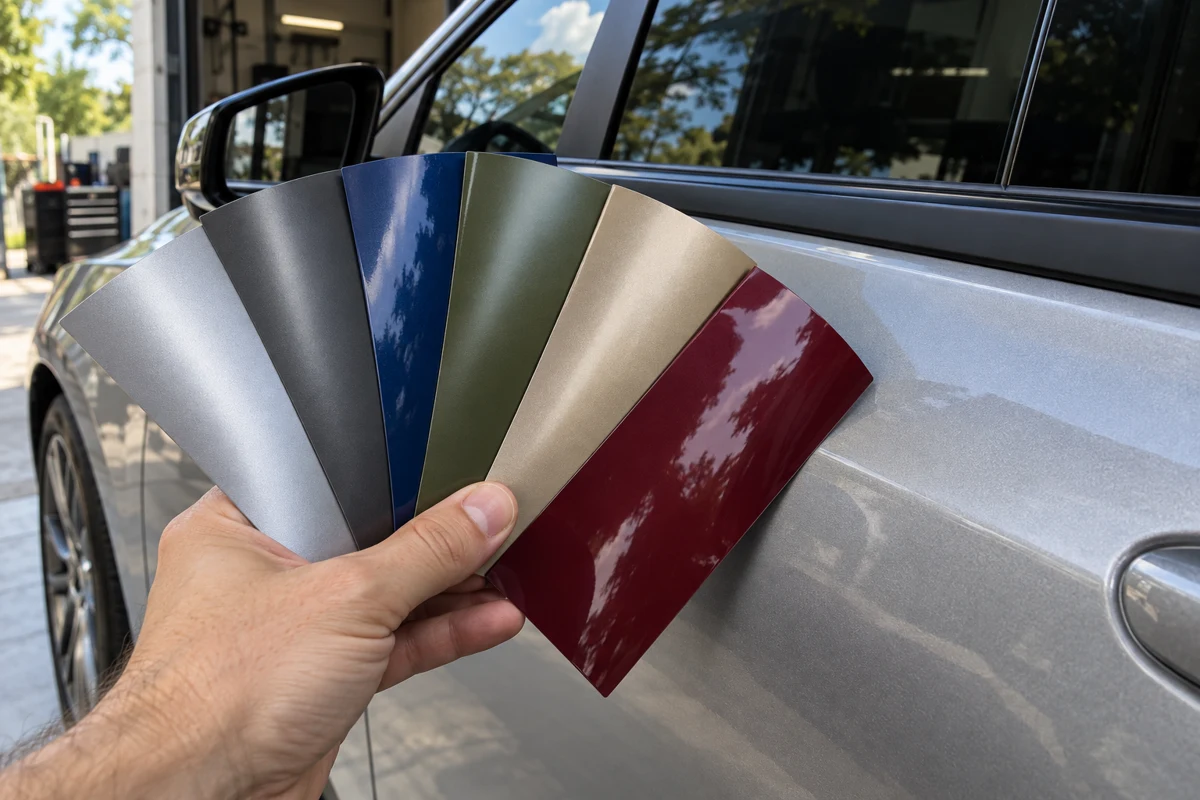
- Identify the exact sample. Record the manufacturer, film series, color name, finish and product code. Keep a reference photograph of the labelled swatch.
- Compare several lighting conditions. Inspect it in daylight, open shade and ordinary workshop light. Move the sample and your viewing position to see the changes.
- Use the car as the reference. Hold the sample near a broad panel, wheels, window trim and original paint that will remain visible. Keep the candidates together for a direct comparison.
- Approve enough surface to judge the finish. If a swatch is too small, ask about a larger curved display sample. A trial application on the vehicle needs agreement about paint suitability, removal and any charge.
- Record the final choice. Put the precise film details and coverage in the quote. If the approved material becomes unavailable, review a replacement sample before accepting a substitution.
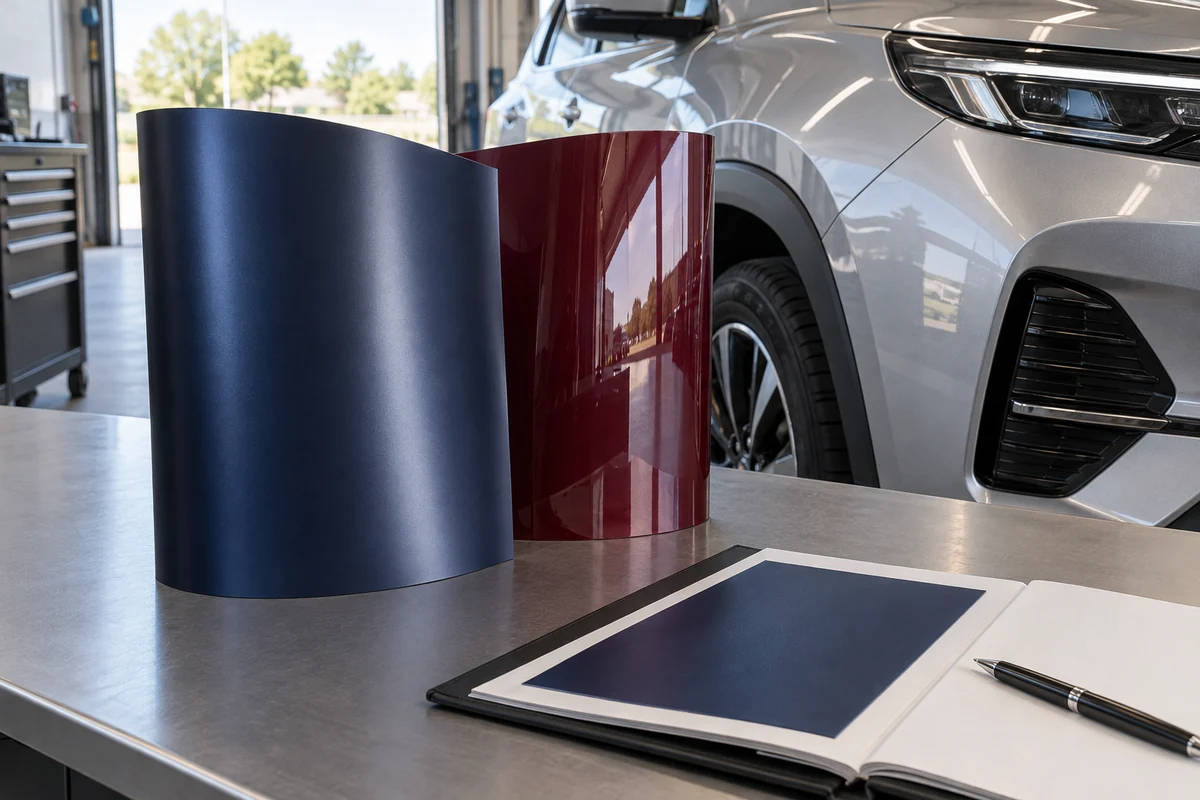
A phone mockup is useful for checking the overall design, especially roof accents and two-tone layouts. Treat it as a layout preview. Screen settings, editing and camera exposure can change the color, so the image should not replace the physical approval.
Make the color work with trim and coverage
Look at the whole vehicle before choosing extra accents. Wheels, grille, mirrors, roof, window surrounds and exposed paint already create a palette. One main color with a considered secondary finish often makes the decision easier than several similar shades competing for attention.
Decide whether the roof remains its original color, whether mirrors match the body and where any two-tone boundary will sit. Describe those choices in the coverage plan. A photograph marked with the intended areas is clearer than an instruction to wrap “everything”.
External panel coverage may leave door openings and other concealed painted areas unchanged. Open the doors and inspect the original color against the sample. A strong contrast can be intentional, but it should not be a surprise at collection.
Metallic, pearl and directional films need a consistent installation plan. Ask how the installer will keep the material orientation aligned across neighboring panels. Turning a sample can help reveal the effect, but the film's application instructions must determine the fitting direction.
Turn the color shortlist into a design brief
Choose one main idea before adding accents. A single body color, a contrasting roof and a printed livery need different approval records. Bring two or three references and describe the part you like, such as soft reflections or a dark upper cabin.
| Design direction | Approve on the car | Record for the quote |
|---|---|---|
| One main color | The sample beside wheels, trim and exposed paint | Exact film, sheen and covered panels |
| Two-tone or accents | Boundaries around pillars, roof edges and rear panels | Which finish covers each surface |
| Printed design | Front, side and rear layouts plus a production sample | Artwork, print film, laminate and file retention |
Make two-tone boundaries follow an agreed panel line or design line. Show how the roof treatment ends around pillars and rear glass. Check stripes across the hood, roof and trunk, including handles and gaps that interrupt the composition. The full versus partial wrap comparison explains how to specify those coverage boundaries.
Printed graphics put a fixed design across the vehicle. A color-flip film changes its apparent tones with lighting and angle. Choose which result you want before selecting the production method. Broad graphic shapes remain easier to read from a distance than details that disappear across curved panels.
For a printed layout, approve a sample made with the intended film, ink and laminate. A digital mockup establishes placement, while a production sample helps establish color and sheen. Our vehicle graphics service covers artwork and production planning.
- Record the vehicle, current paint condition and trim that stays visible.
- Identify one preferred design direction and the exact sample references.
- Mark covered panels, excluded openings and every two-tone boundary.
- Approve the front, side and rear appearance under ordinary lighting.
- Keep the final material and artwork records for later panel repairs.
If impact protection is the priority, select a suitable protective film before choosing the palette. A color effect does not establish the material's protective performance. For environmental claims, ask what the claim covers and how the complete installed material will be handled when removed.
Choose a named film rather than a color nickname
Terms such as racing green, Nardo-style gray and champagne describe a general idea. They do not identify one universal vinyl color. Different brands can use similar names for visibly different products. The product code and physical sample make the choice reproducible.
3M Wrap Film Series 2080 includes gloss, high-gloss, satin, matte and special-effect options. Avery Dennison's Supreme Wrapping Film range also spans several color and finish groups. Compare actual candidates within those ranges rather than assuming a whole brand has one appearance or warranty.
For example, Avery's published selection includes Gloss Metallic Silver SW900-803-M, Gloss Carmine Red SW900-436-O and Satin Black SW900-197-O. Use these references to request samples. Confirm local availability, the current code and the material offered for your job.
When the quote includes printed artwork, identify the print film, inks and protective laminate as a system. A printed solid color should not be assumed to match an off-the-shelf color-change film. That distinction matters for later replacement panels as well as the original finish.
Use current catalog releases to find real alternatives
Avery Dennison's May 2026 Supreme Wrapping Film release added Gloss Ivory, Gloss Sand Dune, Satin Metallic Cyber Green, Matte Metallic Oasis Blue and Gloss Metallic Gothic Rose. These are named sample options across neutral, metallic and lower-sheen finishes. Ask which are available through the local supplier before building a design around one.
A catalog release confirms a product option. It does not establish which shade is most popular in Dubai. Use the physical sample, intended material and care requirements to make the decision.
Check care and exposure before choosing
Your parking and washing routine should influence the material decision. Tell the installer whether the vehicle spends most days outdoors, uses covered parking or receives frequent automated washes. Ask for the current care instructions for the exact finish before ordering it.
Do not choose a color on the promise that it will cool the cabin or resist fading indefinitely. A color sample cannot establish either benefit. Film construction, exposure and the vehicle's glass and insulation are separate considerations. White, silver and black still need product-specific assessment.
For matte and satin finishes, check restrictions on polishing and wax-containing products. A treatment that adds gloss can change the appearance you chose. For gloss film, confirm suitable washing and drying methods rather than assuming paint-care products are interchangeable.
Dust visibility depends partly on contrast with the film and the lighting. It is not a reliable ranking of how clean each color will stay. Avoid rubbing dusty vinyl with a dry cloth and arrange a wash method appropriate to the film. Test a proposed care product as directed before treating the full vehicle.
Ask how warranty terms differ for exposed horizontal panels and other applications. A headline duration is not a promise that every finish will look unchanged for that period in Dubai. Obtain the regional material terms and distinguish them from the installer's workmanship cover.
Decorative color-change vinyl and paint protection film serve different priorities. If stone-impact protection is the main objective, discuss the protective material before choosing a color palette. A ceramic treatment or an additional layer also needs compatibility checks and may alter the surface appearance.
Confirm Dubai requirements for the proposed color
Check approval before installation changes the registered appearance of the vehicle. RTA's published color-change guidance directs owners of licensed vehicles to obtain a Dubai Police permit. Its vehicle ownership amendment guidance also requires inspection for a color change before applying for the relevant update.
The color-change requirements guide explains the approval and registration steps separately from vehicle advertising. Confirm the current process for your vehicle and proposed design rather than assuming every partial wrap is exempt.
For reflective finishes, color-flip designs or business graphics, describe the exact intended result when checking requirements. A manufacturer's color chart does not establish road approval. Confirm whether the proposed reflective film or layout is acceptable before ordering it.
Keep the approved color consistent through booking and repairs
A useful color-change wrap quote identifies the material and coverage as well as the total. Ask which panels, returns and openings are included, whether existing film must be removed and whether paint preparation or trim access adds work. Confirm VAT treatment in the written total.
Compare quotes for the same specification. A different finish, a larger coverage area or a revised fitting layout can change the work. A cheaper total does not explain those differences by itself, and a more expensive film does not establish a better fit.
Before booking, confirm that the available roll matches the approved product. If it does not, inspect the alternative and update the written choice. Agree what happens if a material change is needed before installation rather than leaving it to an informal message after the car is dismantled.
Keep the film details after collection. A later repair may need a fresh mirror piece, bumper section or complete panel. The original color name helps identify a candidate, but aging, batch variation and surface changes can prevent a perfect match. Compare a physical sample beside the existing wrap before authorizing replacement.
At handover, view neighboring panels in consistent light and inspect the agreed boundaries. Look for an unexpected color or finish difference, then ask how the film direction and material selection were checked. Record the fitted product and keep the care instructions with the quote.
Common questions
Which car wrap color should I choose for a daily driver?
Start with the colors you like beside your own car, then check the finish and cleaning requirements. Silver, gray, blue and green offer useful starting points, but no color is automatically best for every parking routine, vehicle or owner.
Is satin easier to maintain than matte or gloss?
There is no universal order. Follow the selected film’s care instructions and ask about polishing, cleaners and coatings before choosing. The finish you prefer must fit the way you intend to wash and maintain the vehicle.
Is Nardo gray the same in every wrap brand?
No. A nickname does not identify one production color. Compare physical samples and record the manufacturer, series, color code and finish. A similar name or online photograph is not sufficient to establish a match.
Will a white wrap keep my car cool?
Do not treat a decorative wrap color as a verified cabin-cooling product. Assess the actual film and any substantiated product claims separately. Choose the color from a physical sample, with exposure and care requirements in mind.
Can I choose the final color from a phone image?
Use the image to narrow your shortlist or preview a layout. Approve the material from a physical sample in more than one lighting condition, ideally beside your own car and the trim that will remain visible.
Will a replacement panel match the original wrap?
A perfect match cannot be assumed, even with the same code. Compare the new material with the fitted wrap because batch, aging, fading and gloss differences can affect the result. Preserve the product details for later repairs.
Plan your color choice
Compare a shortlist with our team
Send your vehicle model and two or three preferred colors. The Al Quoz team can discuss sample options, material and coverage before you book.